










American democracy is being reshaped not by voters, but by partisan politics. The result of this struggle is the destruction of your democracy, as disproportionately the few are making decisions for the many.
This criticism of the system is not about who you should vote for. It is about a system built for compromise, now being rigged for the advantage of your own party.
A recent example is the Proposition 50 debacle in California, a use of popular sovereignty to strengthen the grip of a democratic party’s representation of a state. A combination of the outdated Electoral College, the winner-takes-all voting system, hyper-partisan districting and aggressive map-drawing is undermining democratic representation.
In early November, California voted to pass Proposition 50 in response to partisans gerrymandering in other states like Texas. Though supported by popular vote, this act will abandon voting districts drawn by the independent Citizens Redistricting Commission and replace them with congressional districts drawn by democrats.
These new boundaries are structured to switch at least 5 Republican held seats into Democratic, therefore changing California’s election outcome in the upcoming midterm elections 2026, according to CalMatters.
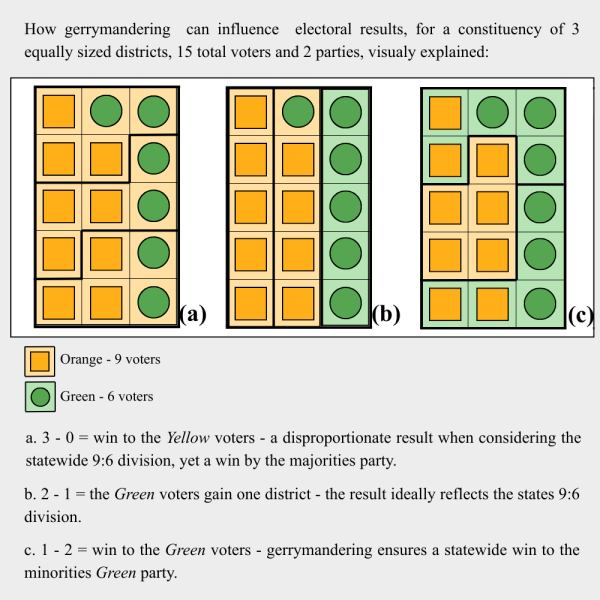
| Gerrymandering, in the contexts of representative electoral systems, is the political manipulation of electoral district boundaries to advantage a party, group, or social class within the constituency, according to Wikipedia. |
Supporters of Proposition 50 noted that this would be a necessary counterbalance to Republican gerrymandering as they “[do] not believe in free and fair elections,” said California’s governor Gavin Newsom.
Nevertheless, democratic fairness is being eroded by gerrymandering and partisan politics, which the recent example of Proposition 50 is a case in point. Even though the measure was approved by two thirds of voters, it is a fact that an independent commissions congressional voting map, meant to avoid partisan politics, was now overridden and replaced with partisan legislatures’ voting districts.
This is an important example, gerrymandering enables the party in power to create voting districts that diminish opponents voters’ impact, also shielding office bearers and reducing democratic competition.
A 2025 poll from POLITICO dramatically shows that American voters in both major political parties by a slim majority support redrawing voting districts in order to favor their own side.
Doesn’t the normalization of gerrymandering move democratic principles like citizens deciding their representatives more to political strategizing behind closed doors? Active exercise gerrymandering will only lead to less competitive districts and less accountability in the legislature.
The endangerment of democracy does not end at voting districts changed to favor your own party; it also goes as far as distorting a majority’s will in presidential elections. Today the United States relies on the Electoral College to elect a President. This has caused candidates who won by popular vote to lose the election, as seen in 2000, when George W. Bush lost the popular vote by over 540.000 votes against his Democrat opponent Al Gore, and 2016.
According to a 2024 survey, by the Pew Research Center, 63% of American adults noted that they would prefer that the presidential candidate who wins by popular vote should also win the whole election, rather than relying on Electoral College votes. This further exemplifies the disconnection between democratic sentiments from the population and the current system.
Furthermore, due to a winner-takes-it-all system in almost every state, votes in “blue” or “red” states are mainly framed as meaningless regarding the overall outcome of the election, while a handful of “swing states” achieve disproportionate and exaggerated influence.
When using a system like this it also means for many Americans that their vote doesn’t carry equal weight, depending on where they live. This conflicts with democratic principles like “one (person), one vote.” Implementing a system that allows presidential candidates to win without the support of the popular vote erodes democratic legitimacy, and voters’ representation is being suppressed.
Some Electoral College supporters argue that this system protects the interest and power balance of smaller states, and prevents immense dominance of larger states, but the question I ask myself is: At what cost? A democratic system in which the majority’s voice is openly, regularly overridden is illegitimate.