






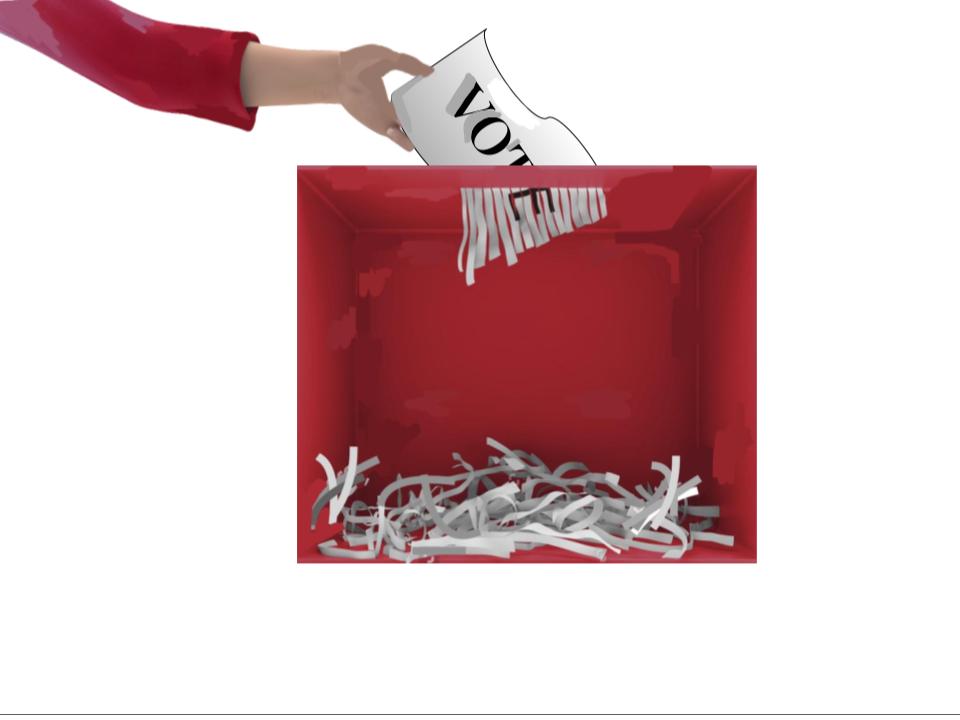
A common sentiment, especially from brand new, 18-year-old voters in my grade, is that they don’t feel inclined to vote. I’ve seen many of my peers say that they would rather not vote at all than have to choose between candidates that they dislike.
I understand. We don’t naturally perceive our individual purpose in the greater political climate of our country; all we see is the ballot in front of us, the chaos around us and the desire to back away from the noise.
Regardless of what they might say, I think that to most of these people, choosing not to vote means that they don’t have to feel responsible for whatever outcome there might be. It’s the same as not pulling the lever in the trolley problem: a trolley is speeding forward, and up ahead, there are 5 people tied to the tracks. You have the option to pull a lever and switch to another track with 1 person tied to it. The people who say they wouldn’t pull the lever argue that if you pulled it, you would become involved in the death of one person. They see not pulling the lever as simply being a passive observer to 5 deaths, and pulling it as being an active participant in a murder.
On an emotional level, I empathize with this feeling. You don’t want to see the blood on your hands of a failing government. You want to be able to tell yourself, whatever cognitive dissonance it may take, that it’s not your fault for the state of your country. You want to be able to sleep soundly. You want to watch the news, thinking “I didn’t vote for this!” witnessing an encroaching military state consolidate more power, scapegoat the oppressed, and allow billionaires and corporations shake us upside down for coins to bolster their gratuitous wealth.
Recently, I’ve felt like the United States is a snake eating its own tail, blighting the privileges that past generations have fought so hard to protect, especially voting rights. There has been a quiet yet active movement in the Trump administration to restrict ease of access to voting. The president has been very vocal in his belief that election processes are rigged, and used this to justify his attempts to disenfranchise voters. In March 2025 Trump signed an executive order to require voters to present “proof of citizenship” when registering to vote with the Election Assistance Commission.
This decision was quickly shot down, of course, because it was an illegal and unilateral usurpation of the powers of congress, the states, and an independent bipartisan federal agency. However, the order is related to a current bill being considered by congress called the SAVE act, which is essentially equivalent, requiring documentation like a passport or a birth certificate to register to vote, which is based on false beliefs of pervasive noncitizen voter fraud in the U.S.
Effectively, what Trump’s executive order would have accomplished if it were passed is a targeted disenfranchisement of millions of American citizens. The order provided a very limited list about what documentation would be acceptable, so the majority of Americans would have to present a passport upon registration. Only about half of Americans have a passport, so this would put tens of millions of eligible voters at risk of losing their right to vote. According to the Brennan Center for Justice, research shows that younger Americans, Americans of color, and lower income Americans are less likely to have ready access to documentation, as well as millions of married women who changed their surname who may not have documentation that matches their new name.
This requirement is criminally redundant. Noncitizen voter fraud is already exceedingly rare. According to NPR, Michigan officials announced in April that a review found that around a dozen noncitizens appear to have illegally voted in the 2024 general election. That’s 0.00028% of the state’s total votes. This is consistent across the United States.
Your vote is already vulnerable. Due to a combination of anti-democratic practices like gerrymandering, lobbying, and the electoral college, American democracy is slowly becoming illegitimate. We are letting our voting rights slip through our hands and the worst part is that many people seem to feel apathetic about it.
There is another group that bases their choice not to vote on principle. These people argue that voting for a candidate they don’t like goes against the universal moral that “Choosing the lesser of two evils is still choosing an evil.” The issue with this mindset is that you are choosing to debase the dignity of our country’s government rather than sacrifice a fraction of personal dignity for the common good.
Your vote is not an endorsement. You do not have to sing the praises of the candidate you choose. You don’t have to plaster your face on a billboard next to them, attend their rallies, or buy their book. You don’t have to engage in arbitrary culture wars or agree with their ideology. In this country, especially in presidential elections, choosing a lesser evil is always the most ethical choice.
And yes, I agree that our country’s two party system is unsustainable and antidemocratic. And yes, I can concede that we need a wider breadth of politicians and presidential candidates alike, especially young ones. But if you were one of the people who chose not to vote in the 2024 presidential election, I ask you to consider what could be different now if Donald Trump hadn’t won a second term. And if you still don’t care, and stand by your choice, then you aren’t paying enough attention.