







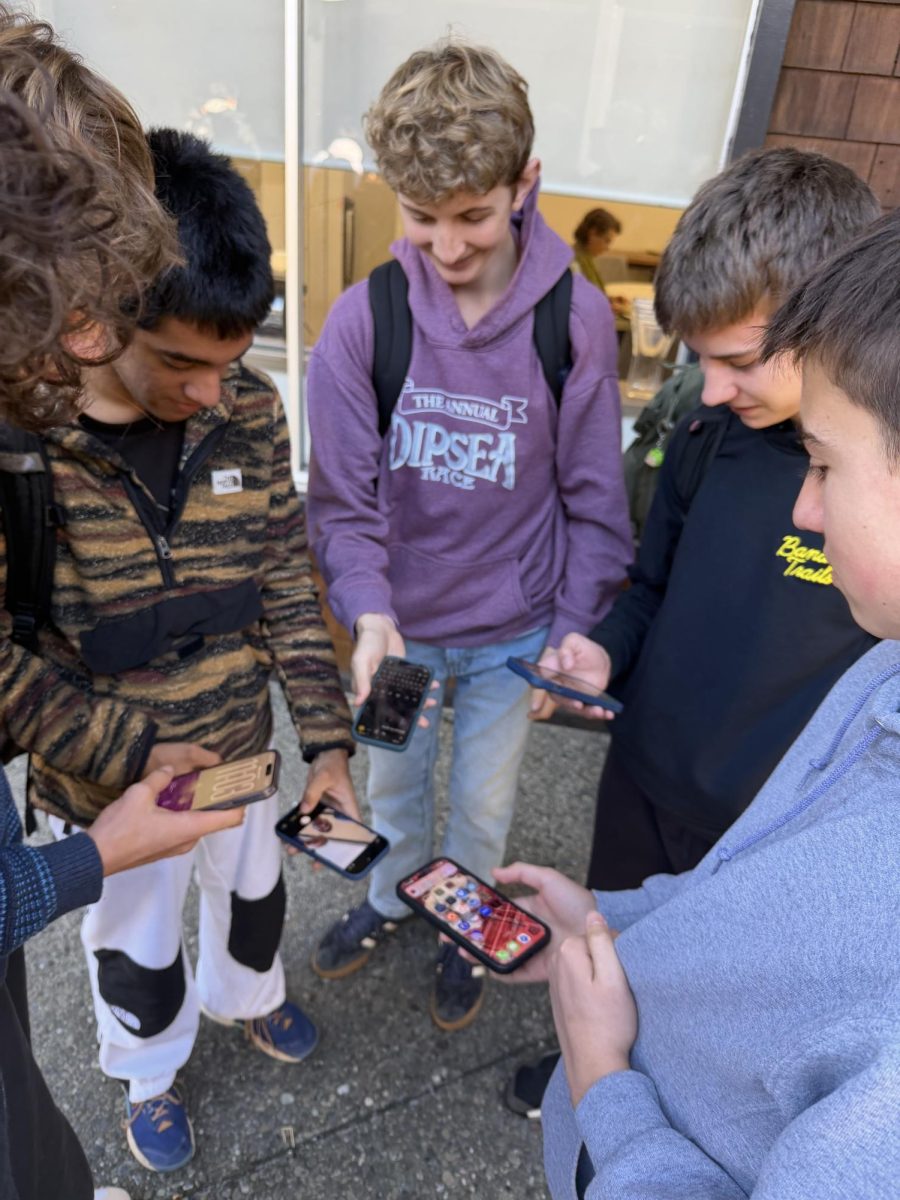
As personal cell phones become more ingrained in modern society and children receive them younger, there is a growing concern about persistent cell phone usage and its effect on socialization and brain health. This year, San Domenico is weighing the benefits of implementing stricter policies on phones. SD says their proposed policies are flexible and open to feedback, and as students, we’d like to join this conversation.
Phones are, for many young people, replacing our time. Not necessarily the time spent outside, playing sports or relaxing and watching a TV show, but the time spent staring out the window on a bus ride, watching popcorn spin slowly in the microwave, or eating breakfast. Our attention is being pulled away from mundane moments. Instead of fidgeting or being creative to self-stimulate, we seek instant gratification through tapping and swiping.
The problem only seems to be worsening. The kids entering high school now were born later in the digital era. The 2026 graduating class, born in 2007 and 2008, remember the genesis of TikTok when we were in middle school. Even though we went through COVID-19 in 7th grade, our brains had developed enough to be able to self-regulate to an extent; most of our early lives weren’t spent on a screen. The 2030 incoming class of freshmen, however, were born in 2012. They went through COVID-19 in 3rd grade, and many experienced formative parts of their early education entirely on a screen, their phones becoming an extension of themselves.
Unfortunately for the next generation, the companies of the digital era target and market to children with personal devices. Attention has become one of the most valuable modern day commodities, and social media companies are in a race to the bottom making efficient systems to convert children’s time into cash. TikTok can get young kids hooked on short form content easily, showing them ads and selling them products. It’s something children are doing away from supervision, so the adults in their lives have trouble understanding the extent of brainless content they consume daily.
Thus, personal cell phones are becoming the norm for increasingly younger children, essentially transforming into the world’s most expensive fidget toys. As these kids grow up and enter high school, teachers and administrators witness this phone usage with increasing concern. Schools across the United States are implementing cell phone policies with varying levels of effectiveness. These policies can range from having students keep phones in their bags during class, to handing it in to the front office for the day.
The risk with many of these restrictions is the erosion of mutual trust. This type of policy can be very effective in a middle school environment, where adults are making most of the decisions. But high schoolers often see these kinds of policies, particularly the ones with harsh repercussions, as overbearing. There’s a double standard where Juniors and Seniors are expected to find a career path that suits them, think about their future, apply to colleges, and show up as leaders; yet, we’re not trusted enough to internalize lessons about self-regulation and phone usage?
Students are eager to understand what this new policy entails. In order to clarify these questions, The Panther Press asked the Dean of Students, Stacey Cohen about what the policy will be and how it will be enforced. Cohen said, “That’s the million dollar question.”
“Enforcing [the policy] becomes us, against you… but that’s not the end goal. The end goal is, how can you see more… that phones have become more of a burden in social aspects during our school days than they’ve been beneficial.”
The Panther Press agrees. There is absolutely no doubt that phones have negative effects on our minds and our social lives.
However, an alternate phone policy in the middle of the year, with no clear rules or means of enforcement is bound to raise questions and concerns from the student body. And rightfully so. What is the policy? What does it entail? Is it a policy that seeks to trust the students? Is it stringent enforcement with penalties? When is it going to be implemented?
Mila Dawson, Junior class president, explained that, “People [students] feel they are being ignored.” She brought up how there are many potential complications like “how [students] communicate with coaches and parents during school hours.”
Cohen said, “It’s not about enforcing, though there will have to be some here and there, because we’re addicted to our phones as adults too. Teachers need to be a part of it, too.”
In that sense, it feels more like a community effort towards healthier living. But Cohen did admit that there would be different rules for students and teachers. “We can’t really take away teacher’s phones,” Cohen said.
This raises the question of equity. Understandably, the school cannot take away faculty phones, but they trust that the faculty is able to self-regulate. If the policy for faculty relies on trust, yet restricts students, we worry it might undermine the values of trust and connection in our community that should be protected. We also wonder whether it’s possible to implement a phone policy that reflects mutual accountability.
San Domenico’s student body generally has a great deal of respect between teachers and students. Currently, the policy is for teachers to collect phones at the beginning of class as students are not allowed to use phones during class time. It’s not too common to see disruptions during class, especially from cellphone usage. Dawson said, “We are being punished for something that is not a very big [issue] at our school.”
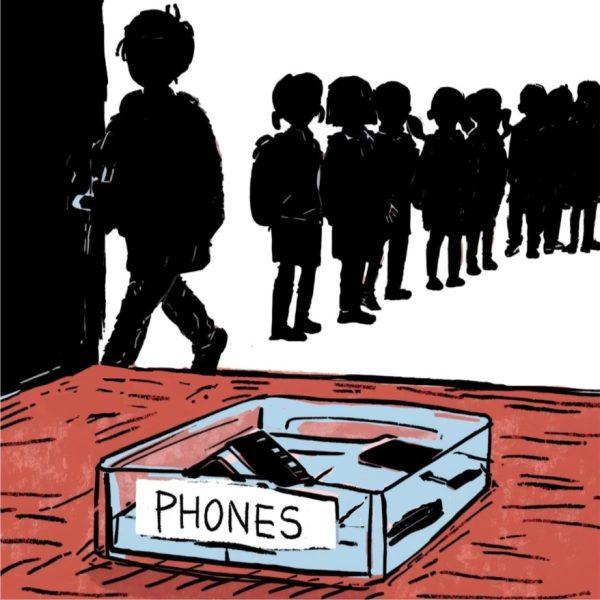
During hours outside of class, including a student’s free time (lunch, free periods, break) students are usually talking and interacting and not only looking silently at their phones. For this reason, Junior Violet Abta, a student who attended the phone meetings this past fall, called the phone policy “unnecessary.” She explained that policies should be made to confront disruptive trends in order to suit the needs of the student body.
Of course, this doesn’t mean excessive phone usage isn’t happening at all. However, the pushback from the student body towards collective punishments has been strong. Many San Domenico Seniors have been frustrated with how Senior privileges are taken away from the whole class when a few students have misbehaved. Punishing everyone for the actions of the few has left many students feeling dejected.
The most effective kind of rule enforcement in high schools is case-by-case punishment. If a specific group in the school is spending too much time on their phones, enforce policies for them.
The most difficult part about phone policies is the fact that people, teenagers especially, are naturally rebellious. When authority tries to enforce rules with unrealistic expectations, the consequence may very well lead to chaos. This is evident in history, like in prohibition. Speakeasies, bootlegging, and illegally distributed moonshine became rampant during prohibition. In some ways, alcoholism became worse. It fostered a culture where breaking the law was normalized and organized crime was glorified. Gangsters transformed into celebrities.
Prohibition and a phone policy are obviously different. Yet, they have similar implications today as students will find ways around the rules. In a school as affluent as San Domenico, it wouldn’t be unfeasible for students to buy second phones if a policy of turning in your phone at the beginning of the day was ever implemented. Students might spend extra time in the bathroom between classes or during lunch to go on their phones, or hide them in their jacket pockets in order to deceive their teachers.
There could be more frequent class disruptions as teachers have to spend time trying to “catch” students misbehaving. Regardless of how harsh a given phone policy is, on a campus as big as San Domenico, effective implementation could require constant surveillance, not to mention that the responsibility of enforcement on teachers adds more to their required duties. Teachers are expected to become phone monitors during their free time.
Additionally, the phone policy could have deeper implications for those who call SD home. Dorian Hohlfeld, a boarding student from Germany, expressed that the new Phone Free Friday policy feels damaging to the student body, only increasing the lack of student-teacher trust here at SD.
“This phone policy, indirectly, undermines the school community,” Hohlfeld said.
He described the policy as “paradoxical.” Instead of building healthier phone habits and fostering connections, they may create “separation and fractured trust between the teachers and students.”
In addition, there are some complications that the administration may not have considered. Restricting phone access could limit familial communication for boarding students. Due to conflicting time zones, many boarders can only talk with their families during breaks between classes. A phone ban could limit and even cut daily connection with family for boarders.
“My parents will not be able to talk to me after 3 p.m.,” Hohlfeld said. “If I text my siblings, dad or mom when I’m on the way to my next class, it’s because that’s the only time when I can effectively do that.”
The most we’ve heard from the administration is that “It’s going to be gradual.”
Nevertheless, a majority of students remain concerned about the effects of the phone rules and how they will impact daily life at San Domenico.
Stacy Cohen has emphasized that she doesn’t envision a world where phones must stay at home, but rather one in which phones are allowed at school in a limited capacity.
“Let’s do some testing. What’s right for our community? Let’s do some trials. Let’s make some mistakes. Let’s be successful. Let’s fail and see what we want; I’m hopeful,” Cohen said.
We are hopeful too. We are optimistic about the future of our school’s policies and the current efforts to improve our community. We also need to be respectful and discerning when we try new cell phone policies. We understand that nothing is solidified yet and nothing has taken full effect, so we believe that open discussion during this time is crucial.
So how can we both curb phone usage and maintain trust?
One proposal is a student-led initiative to encourage less phone usage throughout the day, especially during community times like lunch and breaks. Students respond best to community changes when they are led by their peers. Instead of a top-down approach, a bottom-up approach from a committee of fellow students would be far more effective. We could put up posters or pass out flyers that encourage others to put their phones away and remind people of other fun activities they can do away from their phones.
This committee would have to be an actual reflection of the student body’s voices. They should not be used as an intermediary between the students and the administration or as a way to enforce rules covertly.
We know phones are a problem, and we feel motivated to work together on this. It is important to us that a phone policy doesn’t degrade the aspects of our community that we cherish: our trust and mutual respect. We don’t oppose healthy habits. Rather, we seek fairness, clarity and assurance that our feelings will be acknowledged and our voices heard.